

Liquid Cooling: Belimo and the Future of Data Center Thermal Management
由 Jason Tables
发布于
This is the first installment of a blog series that will discuss the challenges of cooling a modern data center, and cover some of the advanced solutions that Belimo provides to this rapidly changing industry.
The challenges of data center cooling are changing. High-performance computing (HPC), AI applications, and cryptocurrency mining generate significantly more heat than traditional computer servers, necessitating advanced solutions to manage the thermal load effectively and efficiently. Traditional air cooling methods are struggling to keep up with the intense heat generated by these cutting-edge applications, leading to a shift towards more efficient liquid cooling systems which offer improved thermal conductivity.
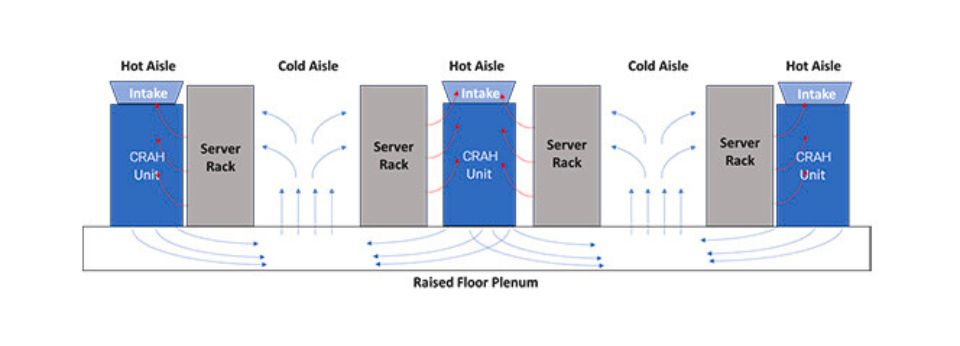
Traditional data center design involves the removal of heat using cool air. Server racks and computer room air handler (CRAH) units are positioned to create “hot aisles” and “cold aisles.” By utilizing a raised floor supply air plenum, the CRAH units provide cool air to the cold aisle. Fans draw the air across the servers, which transfers the heat from the servers to the air, and then dumps this hot air to the hot aisle.
This method has been successfully implemented for decades, even as heat densities have consistently grown. But now, with the exponential rise of generative AI, HPC, and other hyper-intensive computing applications, the industry has reached a critical threshold.
As recently as a few years ago the average heat output from a rack of typical servers was somewhere between 5-10 KW, and as high as 12 KW in some edge cases. But as the tidal wave of new applications has rolled in, heat densities have skyrocketed to as much as 50-100 KW per rack. The “tried-and-true” cooling techniques of the past simply cannot keep up with these extreme loads. Liquid cooling is widely believed to be the gold standard of the future.
Liquid cooling can take several forms, including, but not limited to, rear door heat exchangers, immersion cooling, and direct-to-chip cooling (which is sometimes referred to as cold plate cooling). Each of these applications present their own unique flow control challenges.
Belimo has shown a keen interest in the data center space, developing innovative solutions that simplify and optimize the transition to liquid cooling and support its ongoing operations. By integrating measurement technologies and advanced computational capabilities into standard mechanical valves, Belimo has spearheaded the advancement towards smarter valves, offering functionalities far beyond basic position control.
Traditionally, control valves have relied on position control technology, which correlates the control signal with the valve's opening geometry. This basic technology determines how much of the cross-sectional area is exposed to allow flow through the valve. Analogous to controlling air flow by adjusting the opening of a window, this method can be challenging. Since flow depends not only on the exposed cross-sectional area, but also on pressure differentials, precise control can be difficult.
Flow control, a more advanced technology, refers to the behavior of pressure-independent valves. Unlike traditional methods that control the valve's opening and rely on proper pressure to achieve the desired flow, flow control valves directly regulate the flow rate, often disregarding pressure, and valve position all together. Electronic pressure-independent (PI) valves are particularly well-suited for the liquid cooling industry. Further details on electronic PI valve solutions for liquid cooling applications will be discussed in an upcoming blog post.
Power control builds upon flow control by measuring both flow and the temperature differential (delta T) across a heat transfer device. Using this data, the valve can interpret a control signal from the Building Automation System (BAS) as a power requirement. Based on the measured delta T of the water, it can modulate the flow in order to exchange the specified amount of thermal energy, whether expressed in BTUs per hour (BTUh), tons, kilowatts (KW), or other units.
Differential pressure control is a fundamentally different approach. According to physics, flow capacity (Cv) and flow rate are directly proportional, rising and falling simultaneously. By maintaining a fixed differential pressure (DP) across a circuit, a valve can adjust the flow rate to match changes in flow requirements. If components are removed from a circuit, such as when a server is taken out of the rack for maintenance, the valve will reduce the flow accordingly to maintain the fixed DP. This type of control is particularly relevant for liquid cold plate applications, which will be explored in detail in a future post.
This blog series will provide an in-depth look at the advanced technologies that Belimo offers to the data center industry. We will also cover developing trends in terms of equipment, control strategies, and system design as this exciting field continues to evolve.